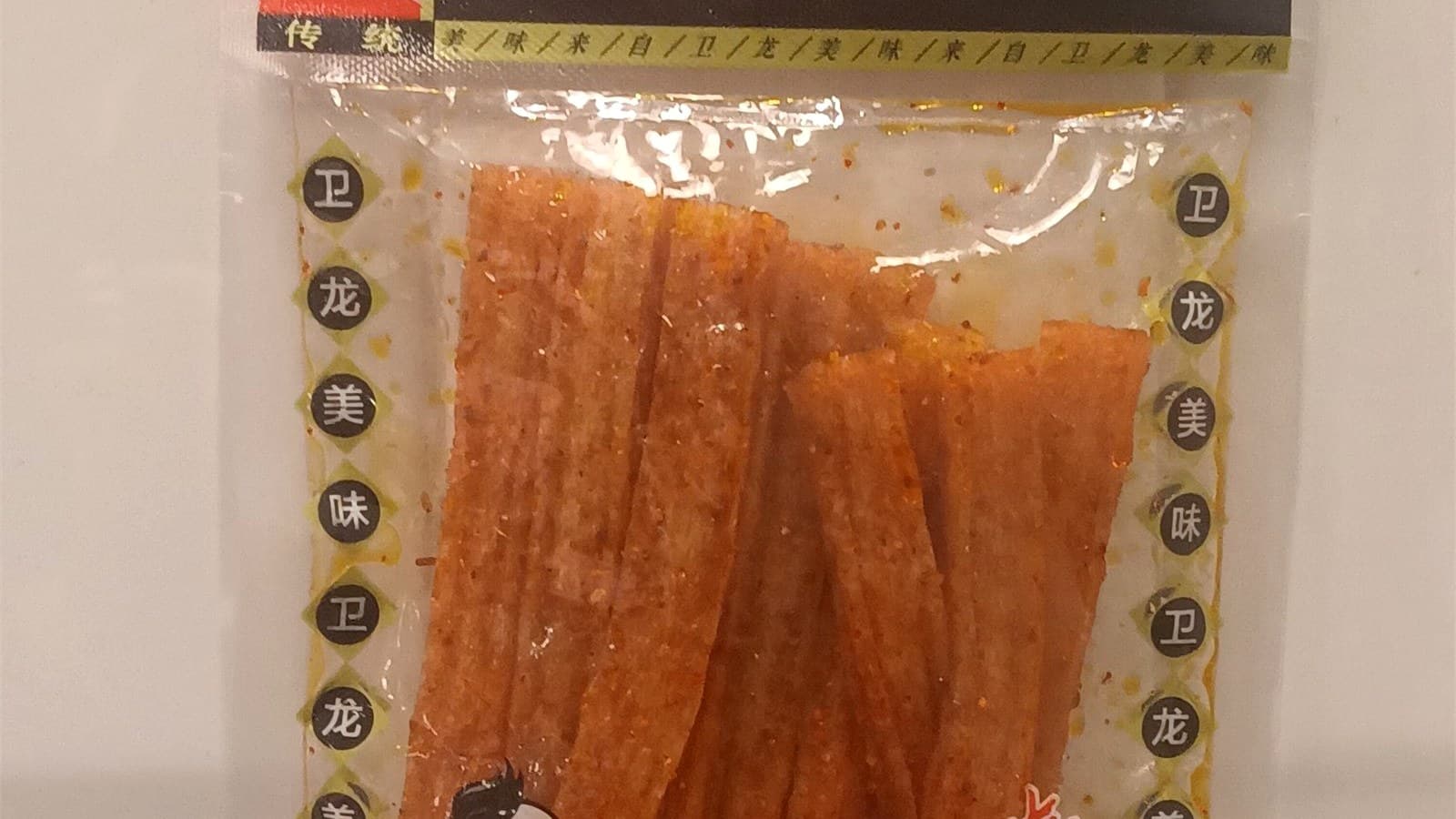
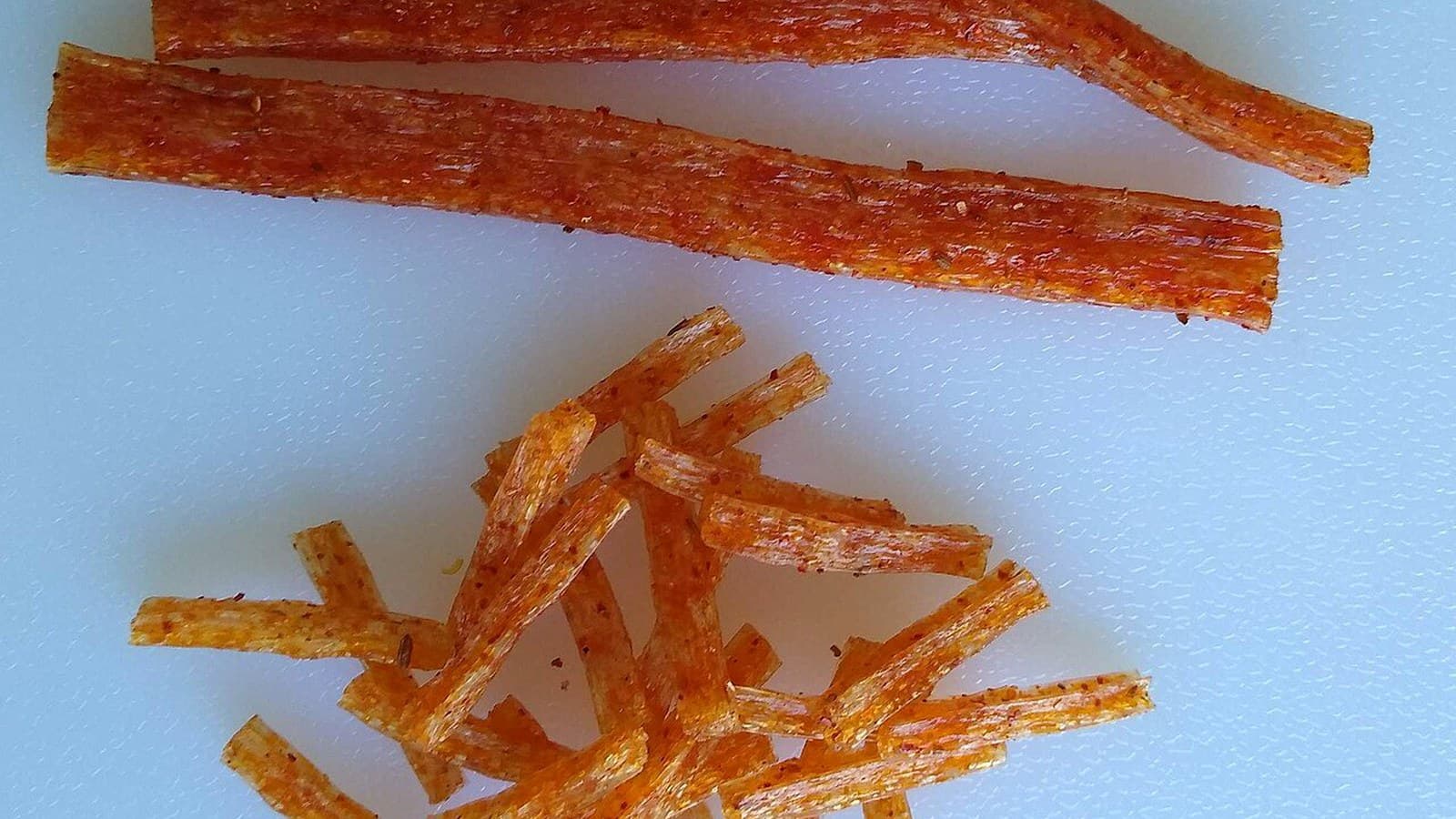
Most mainstream latiao sold to first-time buyers is wheat-based. That matters because the chew people remember is not accidental; it is the result of hydration, structure development, cooking, shaping, seasoning, and packaging control. If you want a consumer-facing example, compare this guide with the Weilong review.
What “Wheat-Based” Usually Means
In everyday snack language, wheat-based latiao usually means the product relies on wheat flour, wheat gluten, or a closely related dough base that can become elastic after mixing and processing. The goal is not a fluffy snack. The goal is a dense, flexible chew that can carry chili oil and seasoning without falling apart.
That is why wheat-based latiao often feels:
- chewy instead of crisp
- glossy instead of dry
- savory and oily instead of airy
Core Process Flow
Most factory lines follow some version of this sequence:
A typical wheat-based latiao line moves the dough through eight stages. The exact order changes by factory, but these are the stages that usually decide the final eating experience.
Raw material staging
Flour, gluten, oil, chili seasoning, salt, sugar, and additive systems are weighed before the line starts.
Mixing and hydration
Water is added in a controlled ratio so the dough develops elasticity.
Forming or extrusion
The dough is shaped into strips, sheets, or thicker pieces.
Cooking or steaming
Heat stabilizes the structure so the product keeps its chew.
Cooling and cutting
The line reduces temperature, then cuts to the final snack format.
Seasoning
Oil, chili, sweeteners, and umami ingredients are applied in a drum or mixing system.
Resting and flavor equalization
Some products benefit from a short holding time so seasoning distributes more evenly.
Packaging
Weighed portions move into bags, usually after inspection and metal detection.
8-Step Parameter Master Table
The ProcessFlow above shows the sequence; this table gives the measurable parameter for each step that decides quality:
| Step | Industry-typical parameter | Standard reference | Quality risk if out-of-range |
|---|---|---|---|
| 01 Raw material staging | Wheat gluten protein ≥75% | GB/T 21924-2008 (vital wheat gluten) | Below 70% protein → weak elasticity |
| 02 Mixing and hydration | Water 35–45% mass, 60–120 RPM × 4–8 min | Cereal Chemistry literature | Less than 30% water → no network; over 50% → slurry |
| 03 Forming or extrusion | Twin-screw barrel 80–95°C, 200–400 RPM | Food Machinery & Equipment 2020 | Below 70°C → poor structure; above 100°C → scorching |
| 04 Cooking or steaming | 95–100°C, 15–25 min, conveyor 0.3–0.6 m/min | GB/T 22427.6-2008 viscosity | Less than 12 min → uncooked; over 30 min → tough |
| 05 Cooling and cutting | 20–25°C ambient, 10–15 min | Standard food cooling | Above 30°C → moisture redistribution skipped |
| 06 Seasoning | Drum 12–18 RPM × 8–15 min, feed 35–45°C | See seasoning page | Above 25 RPM → breakage; under 5 min → uneven coating |
| 07 Resting and equalization | 30–60 min, 20–25°C | Industry standard | Below 15 min → wet/dry gradient remains |
| 08 Packaging | Center temp ≤30°C at sealing, residual O2 less than 2% | GB 19295-2021 + nitrogen flush spec | Sealed warm → condensation inside; high O2 → fast oxidation |
Industry-typical wheat latiao extrusion runs barrel zones 50-70-85-95°C, with screw RPM 200-400, per Food Machinery & Equipment 2020 review.
Three Capacity Tiers and Investment
Wheat-latiao production lines come in three meaningful tiers. Knowing which tier a brand operates at explains a lot about consistency and pricing:
| Tier | Output (kg/h) | Investment (RMB) | Footprint | Typical buyer |
|---|---|---|---|---|
| Small | 50–100 | 20–40万 | 80–120 m² | Startup, small regional brand, OEM cooperator |
| Mid | 200–500 | 60–150万 | 200–400 m² | Regional brand, mid-size factory |
| Large | 800–1,500 | 250–500万 | 600+ m² | National brand, listed company (Weilong, BESTORE) |
Equipment supplier clusters by tier:
- Small/Mid extrusion: Jinan Saixin, Jinan Hento, 漯河 (Luohe) Chengda
- Large-scale: Hento + custom turnkey integration via 国机集团 / private engineering firms
- Packaging (all tiers): Foshan Soontrue, Guangzhou Riyue
The buyer-side relevance: when a brand makes ~$0.04/g (Weilong baseline), they almost certainly run mid or large tier. When a brand sells at ~$0.015/g (FEIWANG value packs), they're likely OEM via small/mid tier with thinner margin tolerance.
Producer cluster map · 5 regions
5 production clusters by region with their flagship brands. This component only appears in the wheat-production article — it's the regional clustering map.
Luohe, Henan
Weilong (大面筋 / 小面筋 / 亲嘴烧)
Tier 3 industrial · 800 kg/h+Zhengzhou, Henan
BiBiZan
Tier 2 mid-scale · 200–500 kg/hPingjiang, Hunan
Mala Prince, multiple OEMs
Tier 2–3Changsha, Hunan
YANJINPUZI
Tier 3 industrialWuhan, Hubei
BESTORE (HQ + OEM partners)
Listed retailer + OEM mix
Capacity tier comparison · 4 dimensions
3 capacity tiers across 4 dimensions (capacity / investment / machines / output). This component only appears in the wheat-production article — capacity normalization is its specific job.
Workshop
- Capacity: 50–150 kg/h
- Investment: 30–80 万 RMB
- Machines: 5+
- Output: 1.2 t / 8h shift
Mid-scale
- Capacity: 200–500 kg/h
- Investment: 150–400 万 RMB
- Machines: 10+
- Output: 3–4 t / 8h shift
Industrial
- Capacity: 800 kg/h+
- Investment: 500–1,500 万 RMB
- Machines: 20+
- Output: 6–10 t / day multi-shift
Which Step Changes Texture the Most?
For wheat-based latiao, texture is strongly shaped by three decisions:
- how much water goes into the dough
- how aggressively the dough is mixed or extruded
- how the product is cooked before seasoning
Too little hydration can make the product dry and tough. Too much can make it soft and weak. Poor cooking control can make seasoning sit on the outside instead of bonding with the chew.
How the Seasoning Stage Works
Seasoning is more than “pour oil on top.” A useful line needs to control:
- oil dosage
- spice blend uniformity
- mixing time
- product breakage during tumbling
This is why one brand can feel glossy but balanced while another feels oily but flat. The problem is often not the chili alone; it is distribution.
Where the Machines Commonly Come From
For wheat-based latiao and adjacent extruded snack lines, common machinery supplier clusters in China include:
- Jinan, Shandong for extrusion, forming, snack processing, and textured protein equipment
- Henan cities such as Zhengzhou and Luohe for food processing ecosystems tied to spicy snacks, mixers, conveyors, and related line equipment
- Foshan, Guangdong for pillow-pack and other packaging machinery used after seasoning and portioning
These are not the only places making equipment, but they are recurring industrial regions when you look at Chinese food machinery listings and supplier directories.
What a Small-to-Mid Factory Line Usually Includes
A practical wheat-based line often combines:
- flour mixer
- screw conveyor or feeding system
- extruder or forming machine
- steaming / cooking tunnel
- cooling conveyor
- seasoning tumbler
- weighing and packing machine
- metal detector and inspection station
The “latiao taste” consumers talk about is therefore tied to both recipe and line design.
Why Packaging Matters More Than People Think
Once the product is seasoned, packaging becomes part of quality control. A poor seal or slow turnover can turn a lively snack dull quickly. That is why shoppers should still use the buying guide, even when the brand itself is well known.
Source Notes
- GB/T 5506.4-2008 小麦面筋指数测定 (wheat gluten index test) — Chinese national standard underlying the 12–14% protein and 70–85 gluten-index requirements cited above
- GB/T 22427.6-2008 谷物粘度测定 (grain viscosity / gelatinization) — referenced for starch gelatinization at 65–75°C in the cooking step
- Hento Machinery (Zhengzhou) tofu-sheet + extrusion line catalog — manufacturer reference for mid-tier wheat-line components
- Soontrue Machinery (Foshan) packaging line — manufacturer reference for the nitrogen-flush pillow-pack stage
- Cereal Foods World (AACCI) — published twin-screw extrusion process documentation including the 80→160°C zone-temperature sequencing
- Luohe food-industry park public profile — Henan-Luohe regional cluster context referenced for Weilong / BiBiZan production base
Final Take
Wheat-based latiao is a factory-controlled chew. The snack may feel casual in the hand, but the result depends on disciplined hydration, shaping, cooking, seasoning, and packaging. Once you understand that, product differences between Weilong, Mala Prince, and Fan Tian Wa become much easier to explain.
FAQ
Why does wheat-based latiao need such specific protein content (12–14%)?
Lower than 12% protein lacks gluten network strength — the strip won't hold its elastic chew and tends to crumble during seasoning. Higher than 14% creates a tough, rubbery chew that consumers report as "too chewy" or "jaw-tiring." The 12–14% window is the sweet spot for the elasticity that mainstream latiao buyers expect, which is why brands source from specific Henan mills rather than commodity wheat.
Can wheat latiao be made gluten-free using alternative grains?
No, not authentically. The signature elastic chew comes specifically from wheat gluten's protein network. Substituting rice flour, corn starch, or other gluten-free grains produces a fundamentally different texture (closer to puffed rice cake or extruded snack chips) — it would not be recognized as latiao. "Gluten-free latiao" listings are usually mis-labeled adjacent products like rice snacks or konjac chips.
Why do extrusion temperatures need 4–6 zoned barrels?
The dough enters the extruder at room temperature with controlled moisture, then progressively heats through zones (typically 80°C → 110°C → 140°C → 160°C die zone). This gradient develops the gluten network in stages — too fast a temperature ramp causes the protein to set before fibrous structure forms; too slow leaves the strip undercooked and prone to spoilage. Single-zone extruders produce inconsistent texture, which is why workshop-tier production rarely matches industrial line output.