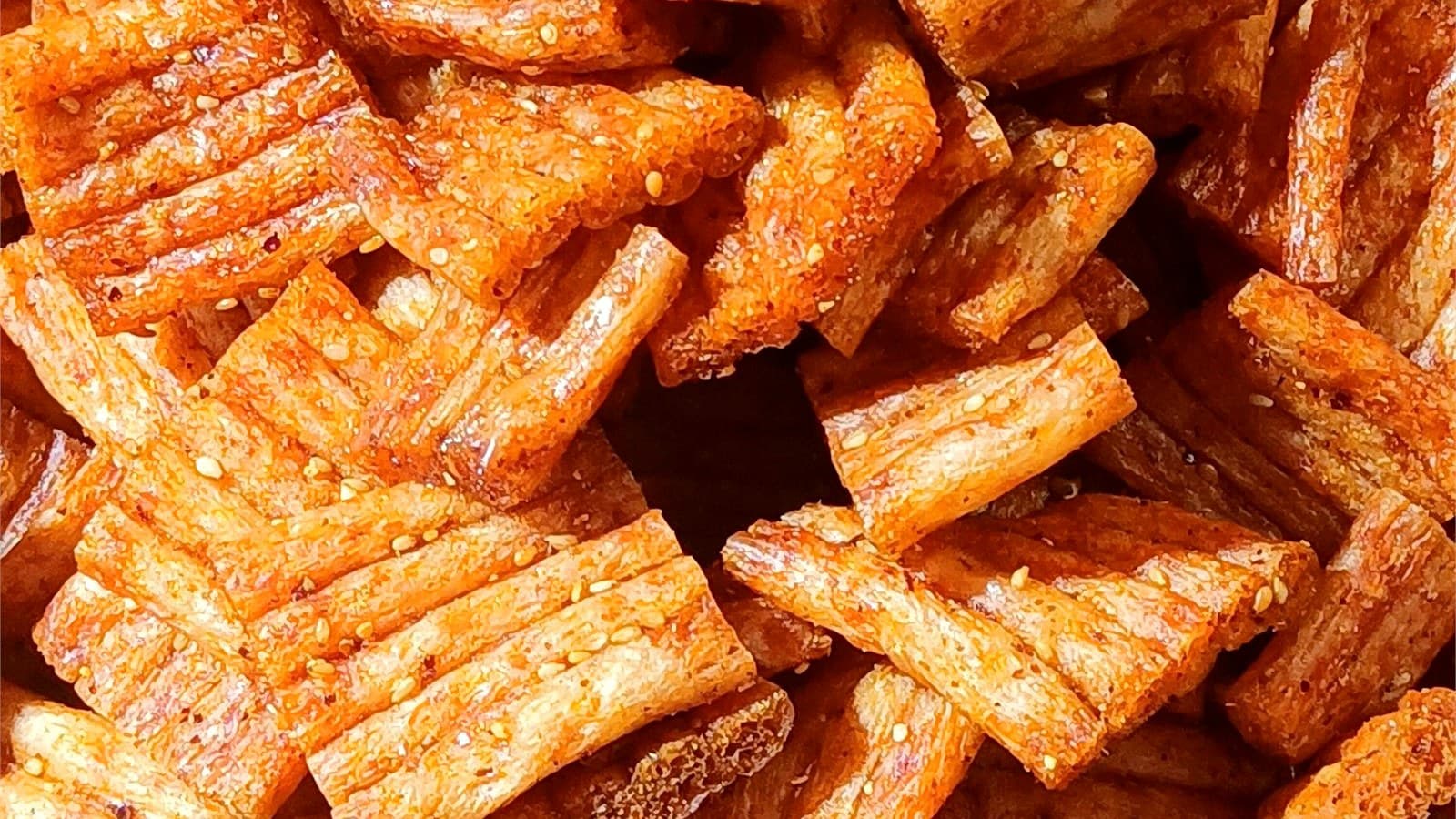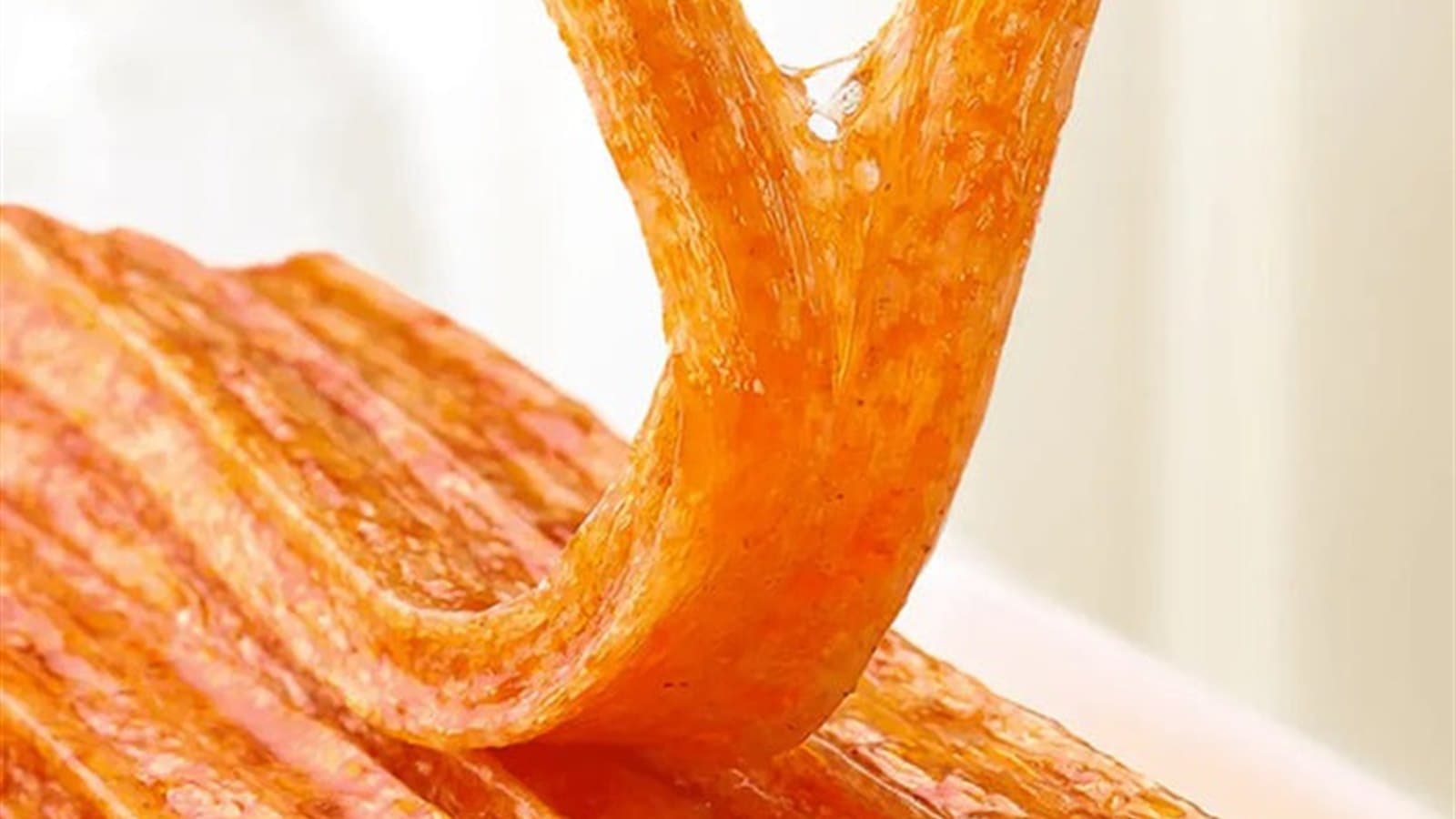
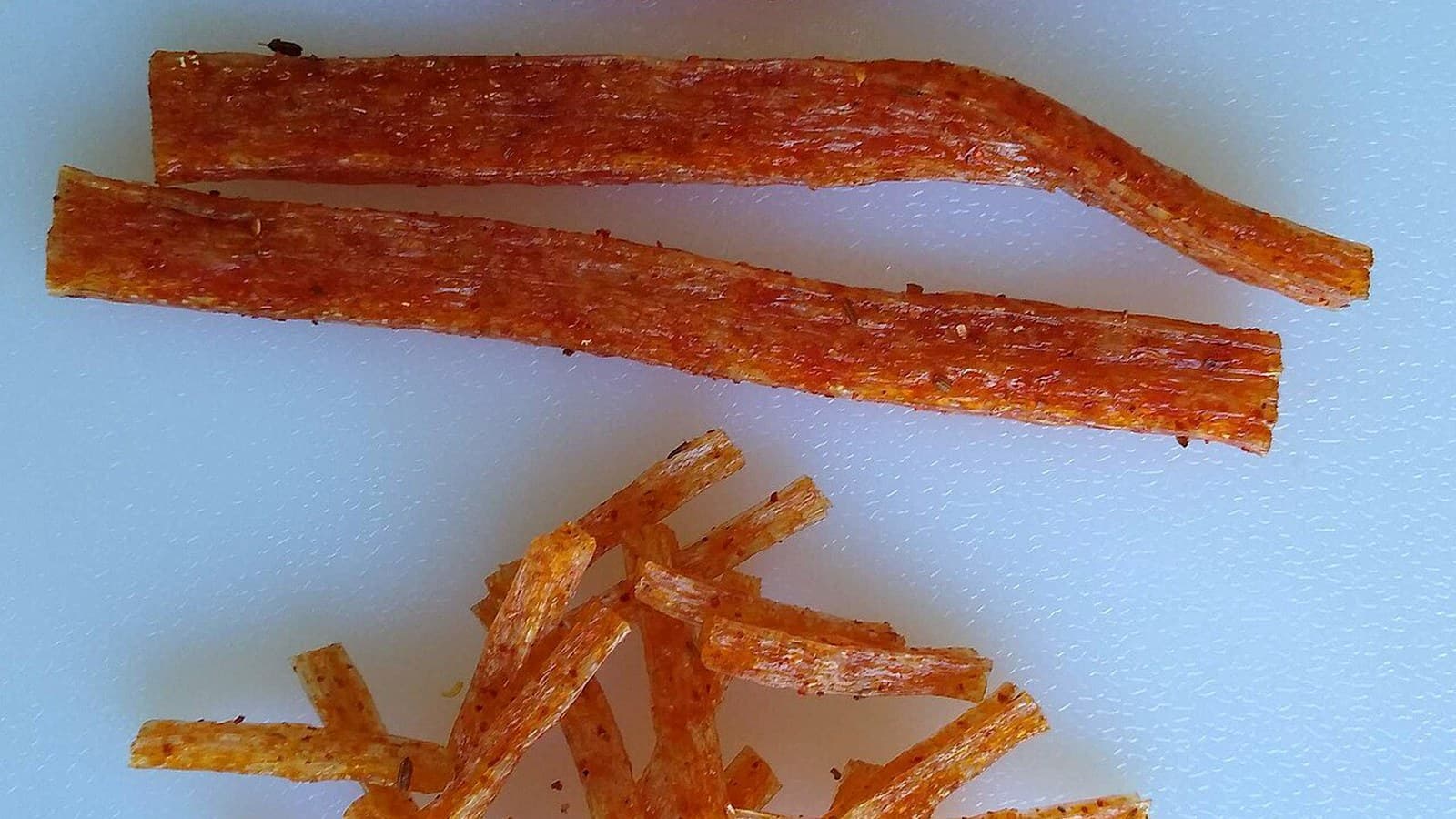
The chew in latiao is not accidental. It is created by water control, mixing, forming, heat, and the way the product rests before or after seasoning. This page focuses specifically on the physical mechanism behind chew formation — how molecules and macroscopic structures come together to produce the elastic, oil-glossy bite reviewers describe.
For the sister topic of texture measurement (TPA instrument data comparing wheat / TSP / tofu-skin), see Wheat vs Soy Latiao Texture. This page is the mechanism; that page is the measurement.
Four Physical Stages Behind the Chew
Wheat-based latiao chew develops through four distinct physical stages — each with a measurable parameter that decides quality.
Stage 1: Hydration (water enters the gluten)
Water is added to wheat flour or vital wheat gluten powder at an industry-typical ratio of 35–45% by mass. This number matters: at hydration below 30%, the gluten can't form a network; above 50%, the network turns into a slurry. Within the 35–45% window, gluten proteins (gliadin and glutenin) unfold and start linking via disulfide bonds.
What this means for chew: too little water → dry, brittle strip; too much water → weak, soft strip; right ratio → elastic baseline.
Stage 2: Mixing and Network Development (disulfide bonds form)
The hydrated dough is mixed at industry-typical 60–120 RPM for 4–8 minutes. The mechanical action lets gluten proteins find each other and form inter-chain disulfide cross-links. This is the protein network. Over-mixing breaks links faster than they form (the dough "breaks down"); under-mixing leaves the network incomplete.
What this means for chew: this stage decides maximum elasticity potential. A latiao mixed too short will never feel springy regardless of later steps.
Stage 3: Cooking and Starch Gelatinization (network locks in)
Steaming at industry-typical 95–100°C for 15–25 minutes does two things: (1) starch granules absorb water and gelatinize at 65–75°C, locking the protein network in place; (2) the gluten network sets into its final geometry. The water activity (aw) at this point is around 0.85–0.92.
What this means for chew: this stage decides final firmness and structure stability. Under-cooked strips collapse later; over-cooked strips become tough.
Stage 4: Resting and Moisture Redistribution (water gradient evens out)
Industry-typical resting is 30–60 minutes after cooking, at 20–25°C ambient. During this time, water migrates from the wet center to the slightly drier surface, evening out the moisture gradient. The final water activity drops to ~0.55–0.65 — the sweet spot for chewy snacks.
What this means for chew: this stage decides eat-mouthfeel evenness. A latiao without proper resting feels "wet" in the center and "dry" on the surface in the same bite.
4 physical stages → final chew
Hydration → mixing → cooking → resting. This component only appears in the chew-forms article — it's the stage-by-stage chew engineering map.
01
Hydration
35–45% moisture
Gluten proteins start unfolding
02
Mixing
60–120 RPM, 4–8 min
Disulfide cross-link network forms
03
Cooking
95–100°C, 15–25 min
Starch gelatinizes, network locks in
04
Resting
30–60 min, aw 0.55–0.65
Moisture redistributes evenly
TPA radar (industry-typical)
Hardness 2,500–4,500g
Cohesiveness 0.45–0.65
Springiness 0.75–0.90
Chewiness 1,500–3,000g
Reading TPA Data Like a Reviewer
When reviewers say a latiao is "too tough" or "too soft", they're describing measurable physical parameters. Texture Profile Analysis (TPA) on a benchtop instrument like the TA.XT Plus translates reviewer words into numbers:
| TPA parameter | Industry-typical wheat latiao | What "too high" reads as | What "too low" reads as |
|---|---|---|---|
| Hardness (g) | 2,500–4,500 | "too tough" / "jerky-like" | "too soft" / "chip-like" |
| Cohesiveness | 0.45–0.65 | "rubbery" | "crumbly" |
| Springiness | 0.75–0.90 | "very bouncy" | "dense, no rebound" |
| Chewiness (g) | 1,500–3,000 | "tiring to eat" | "no resistance" |
| Resilience | 0.35–0.55 | "spring-back" feel | "permanent bite mark" |
Industry-typical TPA hardness for wheat-based latiao falls between 2,500–4,500 g; values above 5,000 g often correspond to reviewer complaints of "too tough", per Journal of Texture Studies methodology. BiBiZan's larger-format grilled gluten typically sits at the upper end (~4,000 g hardness) because the formulation aims for a denser pantry-bag chew. Weilong's Big Latiao sits closer to ~3,000 g, which is why it reads as "balanced" to most first-time tasters.
TPA radar · industry-typical wheat latiao
Industry-typical wheat latiao TPA fingerprint. This component only appears in the chew-forms article — TPA visualization is its specific job.
- Hardness70/100
- Cohesiveness60/100
- Springiness85/100
- Chewiness75/100
- Resilience50/100
Why It Matters for Reviews
When a review says a product is dense, springy, or too tough, it is often describing these production decisions. Compare Weilong with Junzai and you can feel the difference: Weilong's chew feels "balanced" because it sits in the middle of all four parameters; Junzai's chew feels "dense" because hardness and chewiness both run higher.
This is also why a "stale" latiao tastes different from a "fresh" latiao — moisture redistribution continues during storage, and once water activity drops below ~0.45, the gluten network stiffens irreversibly.
Final Take
Chew is a production result. Hydration sets the potential, mixing builds the network, cooking locks it in, resting evens it out — and TPA measurement turns reviewer words into engineering parameters. Once you know the four-stage logic, every latiao review becomes more legible.
Source Notes
- GB/T 22427.6-2008 谷物粘度测定 (grain viscosity / gelatinization measurement) — Chinese national standard underlying step-3 starch-gelatinization measurement
- GB/T 5506.4-2008 小麦面筋指数测定 (wheat gluten index test) — referenced in the 70–85 gluten-index window cited above
- Bourne, M.C. (1978). Texture Profile Analysis. Food Technology — foundational TPA methodology, available via DOI 10.1111/j.1745-4603.1978.tb01218.x
- Journal of Texture Studies (Wiley) — published wheat-gluten product TPA ranges; latest issues at onlinelibrary.wiley.com/journal/17454603
- Cereal Chemistry journal — wheat protein hydration and gluten-network formation literature
- Stable Micro Systems TA.XT Plus methodology — standard texture analyser configuration referenced in industry TPA