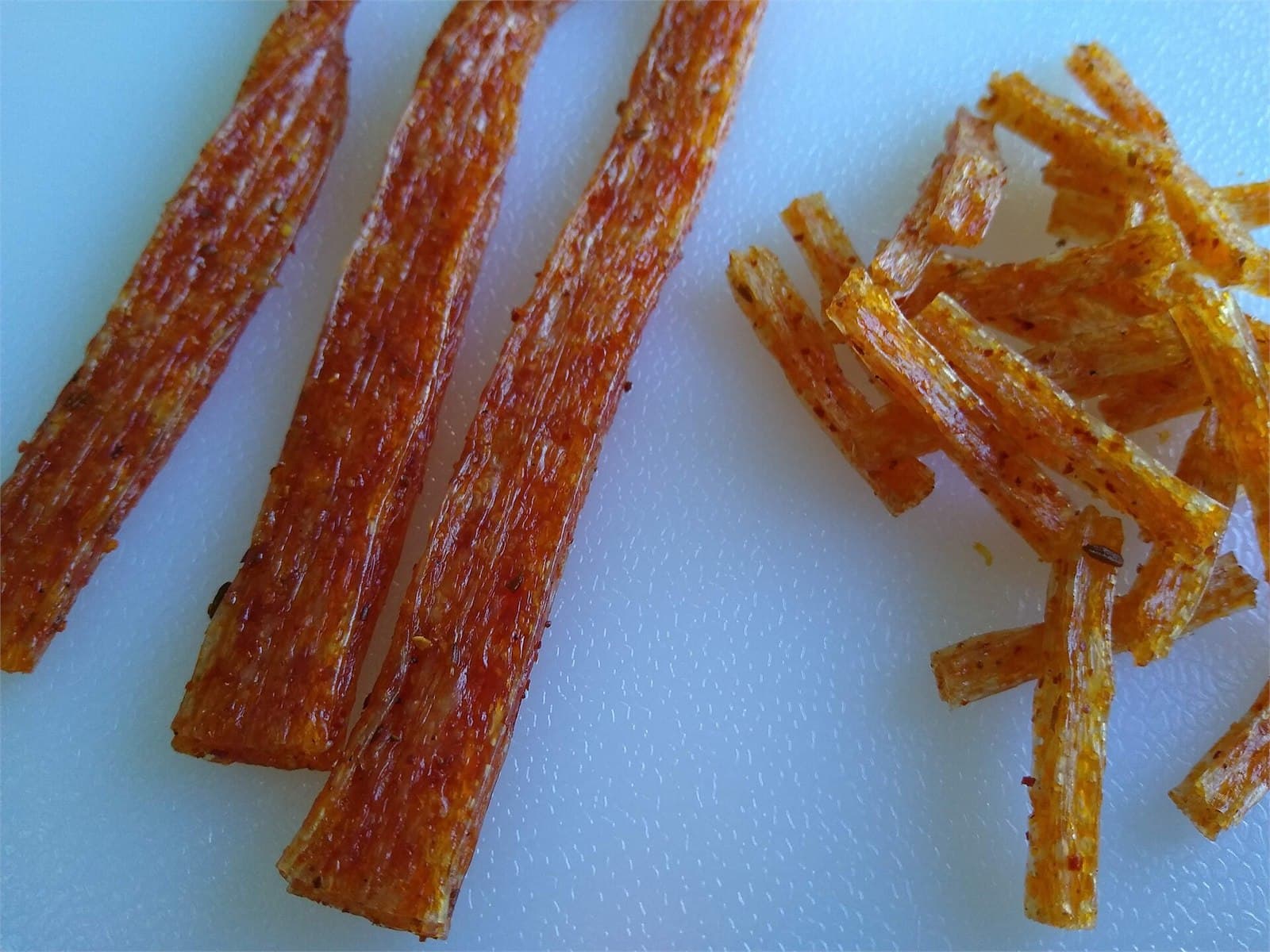
Latiao does not taste like any single familiar snack. The closest comparison is seasoned, oiled seitan — chewy, savory, spicy, and faintly sweet, with a glossy oil finish and a lingering chili warmth. It is not sour, not fermented, not smoky by default, and not explosively hot (unless you pick a high-heat brand).
What this page is: a sensory breakdown covering the five flavor dimensions of latiao, the texture experience, spice-level tiers, and how to choose based on your heat tolerance. What it is not: an ingredient deep-dive — for that, see What Is Latiao Made Of?. For SHU numbers and burn timelines, see How Spicy Is Latiao?.
Quick Answer: What Does Latiao Taste Like?
Five flavor dimensions define the latiao experience:
- Spicy — chili-forward, from mild warmth to numbing má-là
- Savory (umami) — deep, broth-like, from soy sauce powder and yeast extract
- Sweet — subtle balancing sweetness in most mainstream brands
- Oily — rich mouthfeel from 18–28% vegetable oil content
- Chewy — dense, elastic, satisfying — the texture is part of the taste experience
The overall impression is: you bite into something glossy and slightly oily, the chili hits your tongue first, then the savory depth emerges, a faint sweetness rounds it out, and you keep chewing because the texture is genuinely satisfying.
The Five Flavor Dimensions
Spicy (Chili Heat)
Spice is the first thing you notice. Chili is the dominant seasoning in every latiao product, but the type and intensity vary dramatically:
- Chili type: Some brands use straightforward dried red chili for clean heat. Others add Sichuan peppercorn (花椒) for the numbing "má" sensation that makes your lips tingle. A few use fermented chili paste for deeper, funkier heat.
- Heat delivery: The chili is infused into the oil, so it coats your entire mouth evenly. This is different from powdered snacks (like hot chips) where the heat hits in bursts.
- Duration: Latiao heat tends to build gradually and linger. It is not the sharp, fast spike of wasabi or horseradish — it is a warm, spreading sensation that stays for minutes after you finish eating.
Savory (Umami Depth)
After the chili, the savory depth is what keeps you reaching for the next strip. This umami comes from:
- Soy sauce powder — fermented, salty, complex
- Hydrolyzed soy protein — broken-down amino acids that taste like a concentrated broth
- Yeast extract — roasted, almost chicken-stock-like depth
- MSG — rounds out and amplifies every other savory note
Together, these create a flavor that reads as "meaty" even though latiao contains no meat. For many first-time eaters, this is the most surprising aspect — the disconnect between the plant-based ingredient list and the rich, almost jerky-like savoriness.
Sweet (Balancing Note)
Most mainstream latiao includes a small amount of sugar. It is not candy-sweet — the sugar's role is to balance the salt, chili, and oil, preventing the snack from tasting harsh or one-dimensional.
Weilong is the best-known example of the sweet-savory-spicy balance. Their classic strips have a noticeable sweetness that makes them the most approachable entry point for newcomers. Brands like Mala Prince use less sugar, letting the chili and Sichuan peppercorn dominate.
Oily (Rich Mouthfeel)
Latiao is a deliberately oily snack. The surface oil is not a defect — it is how the chili and spice flavors are delivered. A typical bag contains 18–28% oil by weight, which gives latiao its:
- Glossy, appetizing appearance
- Rich, satisfying mouthfeel
- Lingering flavor (the oil carries the spice and umami)
If you are not accustomed to oily snacks, the first impression can be surprising. A practical tip: you can blot the surface lightly with a paper towel to reduce surface oil without losing much flavor. The oil that has already penetrated the strip carries most of the taste.
Chewy (Texture as Flavor)
Texture is inseparable from taste in latiao. The chewiness comes from the wheat gluten network — the same protein structure that makes bread dough elastic and seitan firm. When you bite into a latiao strip:
- It resists slightly, then yields
- You need to chew — it is not a melt-in-your-mouth food
- The act of chewing releases more chili oil and seasoning
- Each chew redistributes the flavor across your tongue
The chew is dense but not tough, elastic but not rubbery. If you have eaten seitan or firm rice cakes, the texture is in that neighborhood — firmer than a marshmallow, softer than jerky, stretchier than a chip.
Spice Level Tiers
Latiao heat spans a wide range. Here are three practical tiers with representative brands:
| Tier | Heat description | Who it's for | Example brands |
|---|---|---|---|
| Mild | Gentle warmth, barely any burn. Sweetness often more noticeable than heat. | First-time buyers, spice-averse eaters, kids | Weilong (classic), BESTORE (some lines) |
| Medium | Clear chili presence, builds gradually. A comfortable buzz, not overwhelming. | Most snackers, anyone comfortable with medium salsa | Weilong (most products), YANJINPUZI, BiBiZan, Feiwang |
| Hot | Strong chili impact, possible Sichuan peppercorn numbness. Lingering burn. | Spice enthusiasts, experienced latiao eaters | Mala Prince, Fan Tian Wa, some Junzai variants |
For a detailed brand-by-brand heat breakdown with SHU estimates, see How Spicy Is Latiao?.
Texture Description
Latiao texture varies by brand, cut, and production method. The three most common texture profiles:
Dense and Elastic (Classic Strip)
The standard latiao texture. The strip is compact, glossy, and springs back slightly when bent. When you bite, it offers firm resistance before yielding. The chew takes 10–15 seconds per piece. This is the Weilong benchmark — what most people mean when they say "latiao texture."
Softer and Lighter (Sheet or Puff)
Some products use a different extrusion process that creates a more aerated, puffed texture. These are lighter, less dense, and absorb oil faster. They often come in larger sheets or irregular chunks. BESTORE and some Genji Food products lean toward this style.
Firm and Dense (Soy-Based)
Soy-protein latiao has a different chew — less elastic, more absorbent, closer to a firm tofu skin or soy jerky. The surface may be less glossy because soy absorbs oil deeper into the structure. ZHUZHIYUAN and some Genji Food lines use this approach.
Latiao vs. Similar Snacks: Taste and Texture Comparison
| Snack | Main ingredient | Texture | Flavor profile | Heat |
|---|---|---|---|---|
| Latiao | Wheat gluten | Chewy, elastic, dense | Spicy, savory, sweet, oily | Mild to hot |
| Beef jerky | Beef | Dry, fibrous, tough | Salty, smoky, meaty | None to mild |
| Hot Cheetos / Takis | Corn | Crunchy, brittle | Salty, tangy, powdered chili | Medium |
| Konjac snacks | Konjac | Rubbery, gelatinous | Mild, broth-absorbed | Mild |
| Seitan | Wheat gluten | Firm, meaty, sliceable | Neutral (absorbs cooking sauce) | None |
| Chili crisp | Oil + chili | Liquid/paste | Spicy, crunchy (from crisp bits) | Medium to hot |
Latiao occupies a unique spot: it has the chew of seitan, the oil content of a dressed snack, the umami of a broth-based food, and the chili presence of Sichuan cuisine — all in a shelf-stable bag.
How to Choose Based on Your Heat Tolerance
If you are unsure where to start, use this simple decision path:
-
If you find hot Cheetos spicy → Start with Weilong classic strips. Mild-medium heat, balanced sweetness, the safest entry point.
-
If you enjoy medium salsa / buffalo wings → Start with Weilong, then try YANJINPUZI or BiBiZan for more chili-forward options.
-
If you seek out spicy food and enjoy Sichuan má-là → Go straight to Mala Prince or Fan Tian Wa. These deliver genuine chili impact and Sichuan peppercorn numbness.
-
If you dislike oily food → Latiao may not be your snack. The oil content is intrinsic to the product. You can blot the surface, but you cannot remove it entirely.
The Best Latiao Brands 2026 page ranks all major brands by heat level, texture, and beginner friendliness.
What to Expect on Your First Bite
If you are about to try latiao for the first time, here is what to expect:
- The wrapper: glossy foil pouch, often with a clear window showing the strips. You may smell chili even before opening.
- First look: strips are glossy, red-orange, with visible chili flakes and sesame seeds. They look wet — this is the oil coating.
- First bite: chewy resistance, then the chili oil spreads across your tongue. The heat builds over 5–10 seconds. The savory depth emerges a moment later, and if it is a sweet-balanced brand, the sugar rounds it out.
- Aftertaste: chili warmth lingers for several minutes. The oil leaves a slight coating on your lips and tongue. You may want water or milk nearby if you picked a hot brand.
A practical tip: eat latiao in small portions. A few strips are satisfying; a whole bag in one sitting can feel overwhelming due to the oil, sodium, and flavor intensity.
FAQ
Does all latiao taste the same?
No. Flavor varies significantly by brand. Weilong is sweet-forward and balanced; Mala Prince is chili-dominant with Sichuan peppercorn; BiBiZan is chewier and more savory. Different brands target different taste preferences.
Is latiao very spicy?
It depends on the brand and product line. Mainstream latiao (Weilong, YANJINPUZI) is medium-spicy at most — comparable to medium salsa. Specialty brands (Mala Prince, Fan Tian Wa) can be genuinely hot. If you are spice-averse, start with Weilong.
Why does latiao taste meaty if there is no meat?
The soy-based umami system — soy sauce powder, hydrolyzed soy protein, yeast extract, and MSG — creates a deep savory flavor that mimics meat-based snacks. It is entirely plant-derived unless the specific brand adds animal-based flavor extracts.
Is latiao supposed to be eaten cold or hot?
Latiao is a ready-to-eat snack designed to be eaten at room temperature straight from the package. Some people warm it briefly (10–15 seconds in a microwave) to soften the oil and intensify the aroma, but this is not standard or necessary.
What drink pairs well with latiao?
Cold milk or soy milk is the most effective for cooling chili heat. Beer (especially a light lager) is a popular pairing in China. Avoid carbonated soft drinks — the carbonation can amplify the chili burn.
Related Guides
- What Is Latiao Made Of? — full ingredient breakdown and production process
- How Spicy Is Latiao? — SHU estimates and brand heat comparison
- Best Latiao Brands 2026 — 10-brand ranking by heat, texture, and beginner suitability
- Best Latiao for Beginners by Heat and Texture — curated first-buy picks
- Latiao vs Konjac & Gluten Snacks — cross-category texture and nutrition comparison