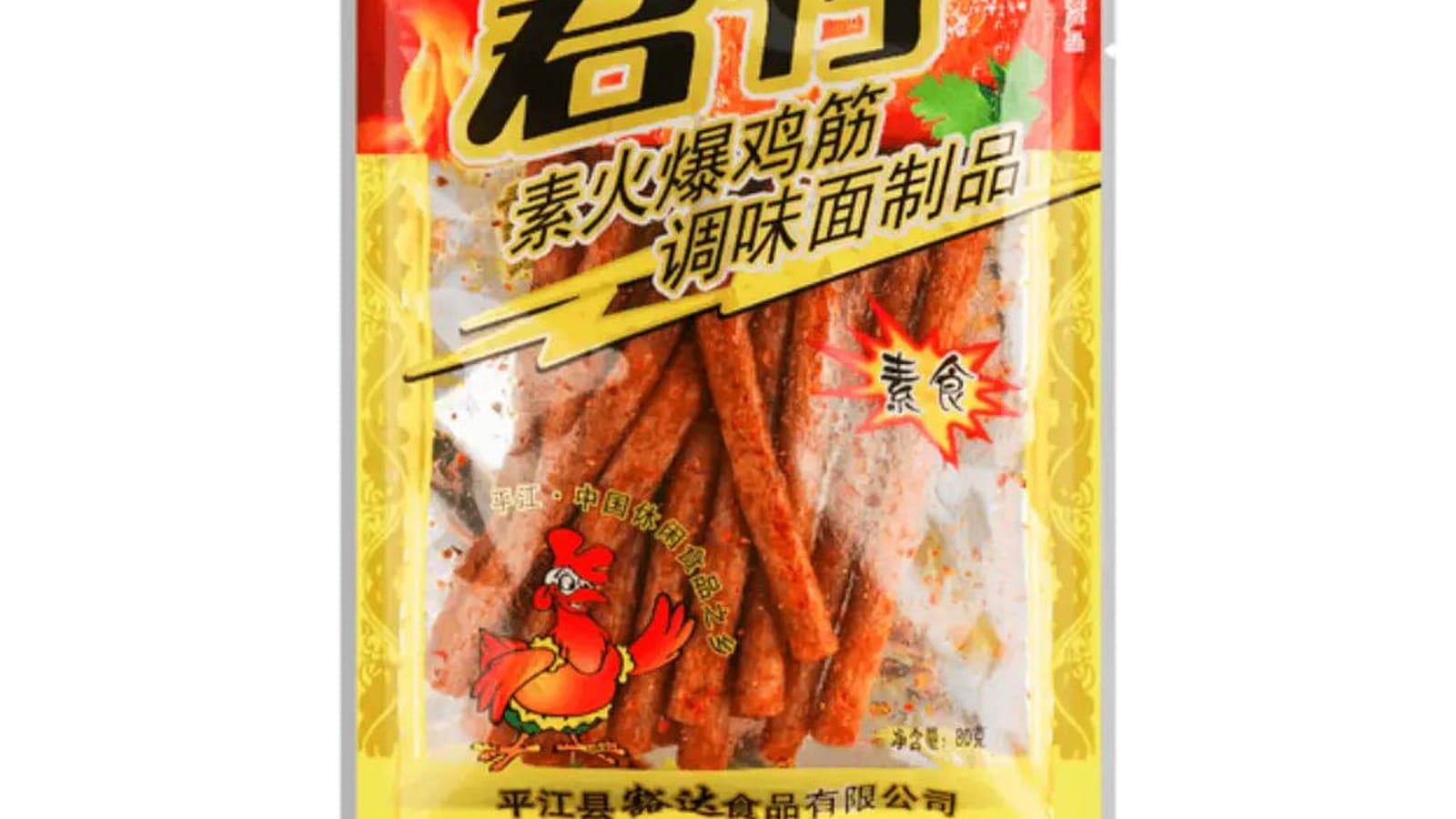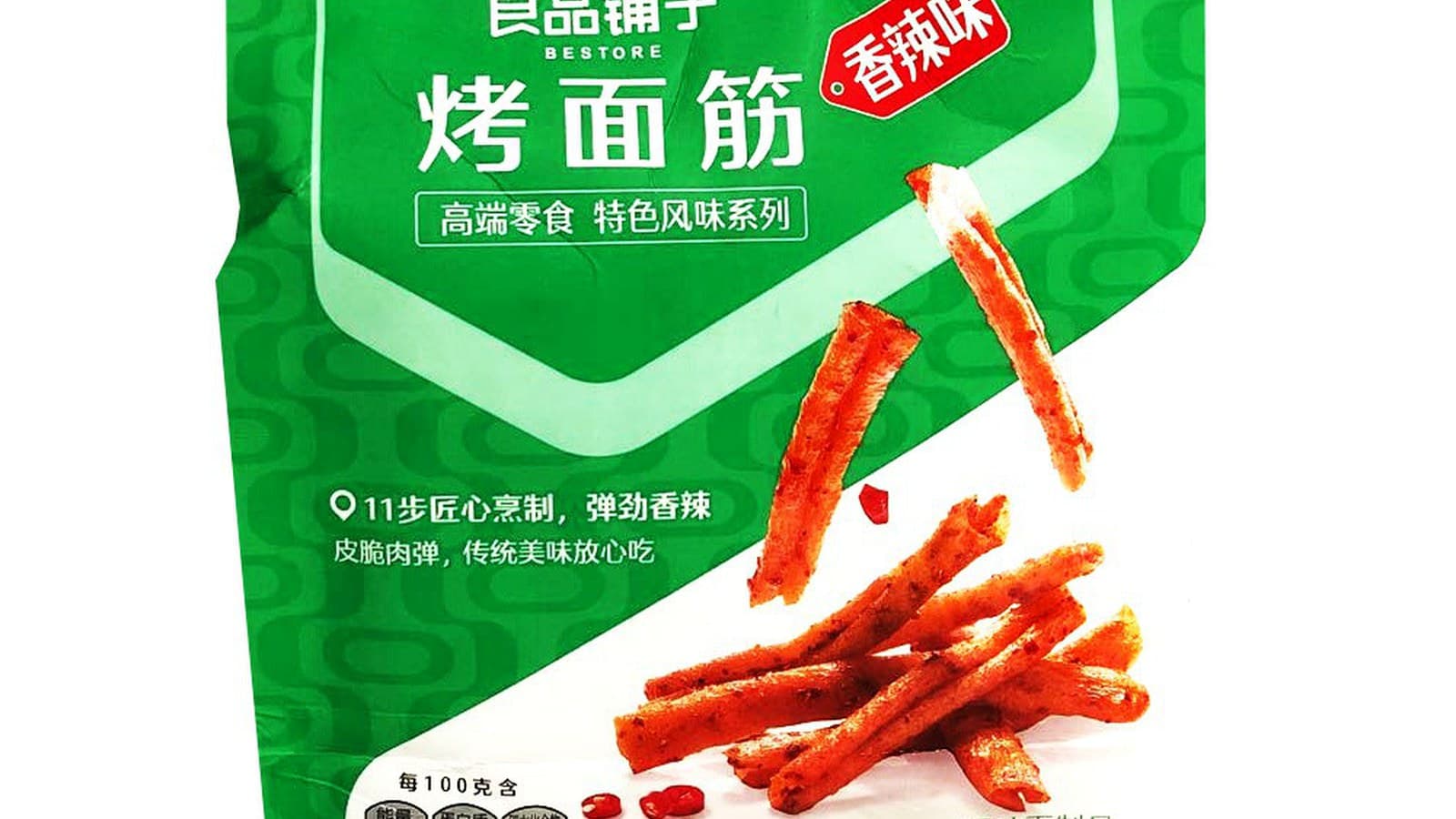
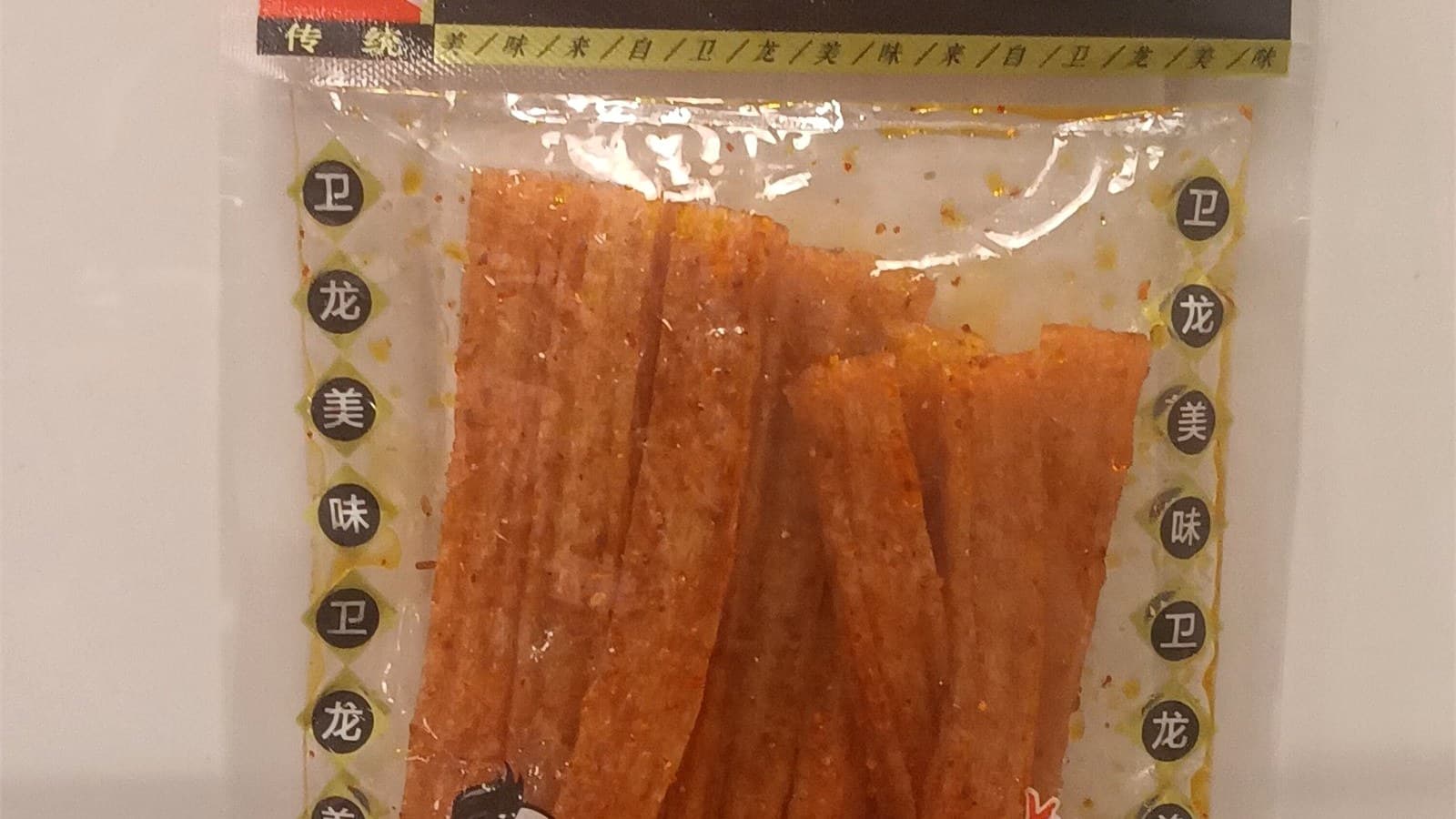
Ingredient lists are not only for dietary checks. They also tell you what kind of product you are buying: wheat-based strip, soy-sheet snack, vegetarian-meat format, or a broader spicy snack.
Anatomy of a Real Latiao Label
A standard Chinese-printed latiao back panel has 6 distinct information zones, each governed by a different GB regulation:
| Zone | Content | Governing standard | What to look for |
|---|---|---|---|
| 1. Product name (品名) | Brand + flavor + format | GB 7718-2011 §4.1 | Should include category word (辣条 / 调味面制品) |
| 2. Ingredient list (配料表) | Listed in descending mass order | GB 7718-2011 §4.1.2.1 | First 3 ingredients tell you protein base + dominant fat + main seasoning |
| 3. Nutrition table (营养成分表) | Per 100g + NRV% | GB 28050-2011 | Always labeled per 100g for cross-product comparison |
| 4. SC license number | 14-digit production license | 国家市场监管总局 | Decode region + factory class (see next section) |
| 5. Production date (生产日期) | YYYYMMDD or YYMMDD | GB 7718-2011 §4.1.5 | Compare to today: ≤4 months = fresh window |
| 6. Allergen warning (过敏原信息) | Mandatory independent statement | GB 7718-2011 §4.4.3.7 | "本品含有/可能含有" prefix |
GB 7718-2011 requires additives at ≥2% to be named explicitly — '调味料(食用盐、白砂糖、味精)' is compliant; '调味料' alone is not. If a product's ingredient list looks suspiciously vague, that's often a regulatory shortcut by the manufacturer.
Chinese back-label · 6 information zones
6 information zones of a Chinese latiao back-label, plus the SC code region prefix decoder. This component only appears in the ingredient-lists article — label anatomy is its specific job.
1. Product name 品名
Brand + flavor + format. Must include category word (辣条 / 调味面制品).
2. Ingredient list 配料表
Descending mass order. First 3 ingredients = protein base + dominant fat + main seasoning.
3. Nutrition table 营养成分表
Per 100g + NRV%, mandatory under GB 28050-2011.
4. SC license 14-digit
SC + [3 category] + [2 province] + [2 city] + [2 county] + [4 sequence] + [1 checksum].
5. Production date YYYYMMDD
≤ 4 months from today = fresh window.
6. Allergen statement 过敏原信息
Mandatory independent statement per GB 7718-2011 §4.4.3.7.
SC code region prefix decoder
41 = Henan (Weilong, BiBiZan) · 43 = Hunan (Mala Prince, YANJINPUZI) · 42 = Hubei · 44 = Guangdong (OEM repackagers)
Decoding the SC Number (Food Production License)
The 14-digit SC code on the back panel is not just a number — it encodes production region and category. Format:
SC + [3 digits product category] + [2 digits province] + [2 digits city] + [2 digits county] + [4 digits sequence] + [1 digit checksum]
Example: SC11441xxxx decodes as:
114= product category (compound seasoning / latiao class typically falls under 1144 or 0509 depending on classification)41= Henan province (河南)- Remaining digits = city + county + factory sequence
Category-region pairs for latiao:
| Region prefix | Province | Major brands |
|---|---|---|
41 | Henan (河南) | Weilong (Luohe 漯河), BiBiZan (Zhengzhou 郑州) |
43 | Hunan (湖南) | Mala Prince (Pingjiang 平江), YANJINPUZI (Changsha 长沙) |
42 | Hubei (湖北) | Junzai (some variants) |
44 | Guangdong | Some OEM packagers |
If you see SC...41... on a Weilong package, that's consistent (Luohe = Henan = 41). If you see SC...44... on a "Weilong" product, that's likely a regional repackager — not necessarily fake, but the supply chain is one step removed from the original factory.
14-digit SC code position-by-position decoder
14-digit SC code position-by-position decoder. This component only appears in the ingredient-lists article — SC decoder is its specific job.
- Position 1–2
SCStatic prefix indicating Food Production License - Position 3–5
[3 digit category]1144 = compound seasoning / latiao class typical - Position 6–7
[2 digit province]41 = Henan, 43 = Hunan, 42 = Hubei, 44 = Guangdong - Position 8–9
[2 digit city]Within the province, identifies the prefecture-level city - Position 10–11
[2 digit county]District / county code - Position 12–15
[4 digit sequence]Factory's sequence number under that county licensing office - Position 16
[1 digit checksum]Validates the entire string against issuance records
Example: SC11441030001234X → Henan (41) Luohe area + factory sequence 0001 → consistent with the Weilong Luohe origin.
Sodium Math: From NRV% to Real Daily Budget
NRV% (Nutrient Reference Value percentage, GB 28050-2011) lets you translate label numbers into "how much of my daily budget."
For a typical wheat-gluten latiao:
- Per 100g: ~2,000 mg sodium → ~100% of WHO daily sodium recommendation
- Per 65g pack (typical Weilong single): ~1,300 mg → ~65% of daily budget
- Per 200g pack (typical Genji 大辣片): ~3,000 mg → 150% of daily budget — single-bag = sodium overload
Practical math you can do at the marketplace listing:
- Read sodium per 100g from nutrition label
- Multiply by (pack weight / 100)
- Compare to 2,000 mg WHO daily ceiling
- If single bag exceeds 50% of daily budget, treat as a sharing portion, not a solo serving
This is the math that turns "is this snack OK for daily eating" from gut feel into a 30-second computation.
Start with the First Structural Ingredient
If the first structural cue is wheat or gluten, expect classic elasticity. If the first cue is soy or bean curd, expect a different bite.
Then Check Oil and Seasoning
Chili, oil, salt, sugar, and savory seasoning define flavor direction. A sweet-oily profile will feel different from a dry, chili-forward one.
Allergen and Diet Cues
Wheat, soy, sesame, and peanut cues matter. Do not rely on marketplace summaries if the package photo is visible.
For Western shoppers, the most important label checks are usually:
- wheat / gluten: classic latiao is commonly wheat-based, so gluten-free buyers need a clear alternative label
- soy: soy sauce, soy protein, or bean-curd formats can appear in both classic and adjacent snacks
- sesame and peanut: chili-oil seasoning systems sometimes use seed or nut cues that matter to allergy-sensitive buyers
- milk, egg, seafood, or meat extract: these can change vegetarian, vegan, or halal expectations even when the base looks plant-based
- may contain statements: marketplace summaries often omit cross-contact notes shown on the package
If the product page has no readable ingredient photo, treat that as a buying risk rather than a small inconvenience.
Calories, Sodium, and Serving Size
Ingredient lists tell you what the snack is, but nutrition panels tell you how to compare formats. Latiao is often oil-seasoned and salty, so a large bag should be judged by serving size, grams, sodium, and calories rather than the headline price.
This matters most when comparing single packs with value bundles. A low price can still be a poor first order if the pack is too large, stale-prone, or unrealistic to finish after opening.
Halal, Vegan, and Gluten-Free Claims
Treat diet claims as package-level claims, not category-level claims. "Latiao" does not automatically mean vegan, halal, gluten-free, or allergen-safe. The safest process is:
- confirm the exact product photo
- read the ingredient panel
- read the allergen statement
- look for certification marks only on the current package
- avoid listings that hide the back label
For a deeper diet-focused walkthrough, read Is Latiao Vegetarian or Vegan?.
Final Take
The ingredient list helps you avoid buying the wrong snack type. It is one of the fastest ways to separate classic latiao from adjacent spicy strip products.
FAQ
What's the fastest 30-second ingredient-list check before buying?
Look at the first three ingredients (descending mass order per GB 7718-2011), the SC code prefix (decode region from the 4th-5th digits), and the production date (4 months or less = fresh window). These three checks take ~30 seconds and rule out 80% of mis-listed products.
Should I trust the English ingredient list on imported bags?
Use it as a starting point, not authority. Chinese-market bags only require the Chinese label to be regulatory-compliant — the English translation on imports is often added by the importer or distributor and may compress 5–10 components into "natural seasoning." Cross-check with the Chinese list (use a translation app on the package photo) when allergens matter.
Why are some ingredient lists much shorter than others for similar products?
Two reasons: (1) GB 7718-2011 allows compound ingredients to be declared as a single name if each sub-component is below 2% (e.g., "调味料" can hide 5–8 actual ingredients); (2) some brands deliberately consolidate non-mandatory listings to look "cleaner." A short list isn't necessarily a cleaner product — it may just be a less-detailed disclosure. Compare brands with similar protein bases for a fair read.
Source Notes
- GB 7718-2011 预包装食品标签通则 (general standard for prepackaged food labels) — labeling structure, ingredient ordering rules, and the 2% sub-component disclosure threshold
- GB 28050-2011 预包装食品营养标签通则 (nutrition labeling standard) — per-100g nutrition table + NRV% format underlying the sodium-math walkthrough
- State Administration for Market Regulation (SAMR) food production licensing portal — the issuing authority for the 14-digit SC code decoded above
- GB 2760-2014 食品添加剂使用标准 — covers preservative ceilings (sorbate, dehydroacetic) cited for shelf-stable latiao
- China General Chamber of Commerce food-industry coverage — sector reference for SC-code regional clustering by province