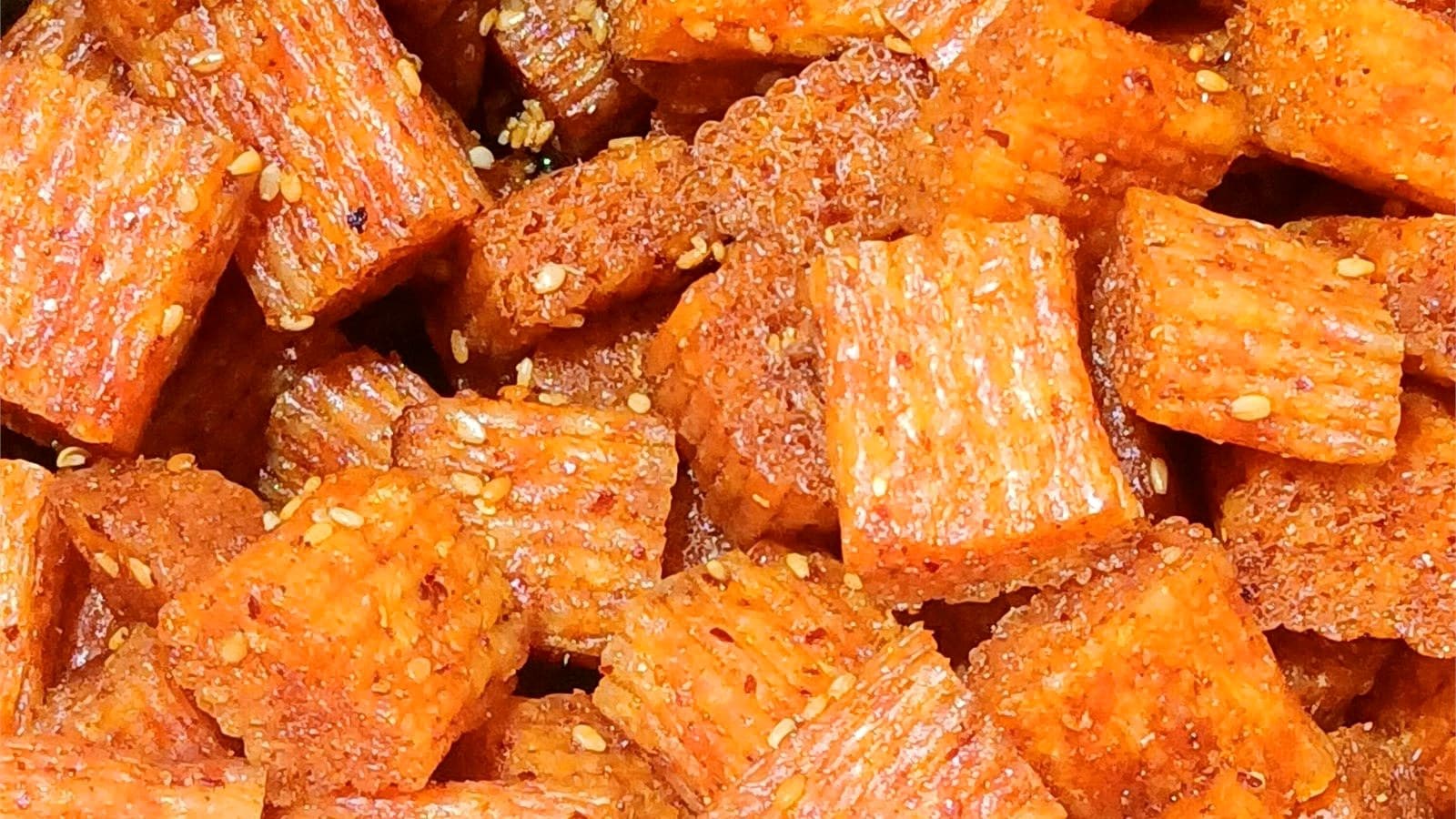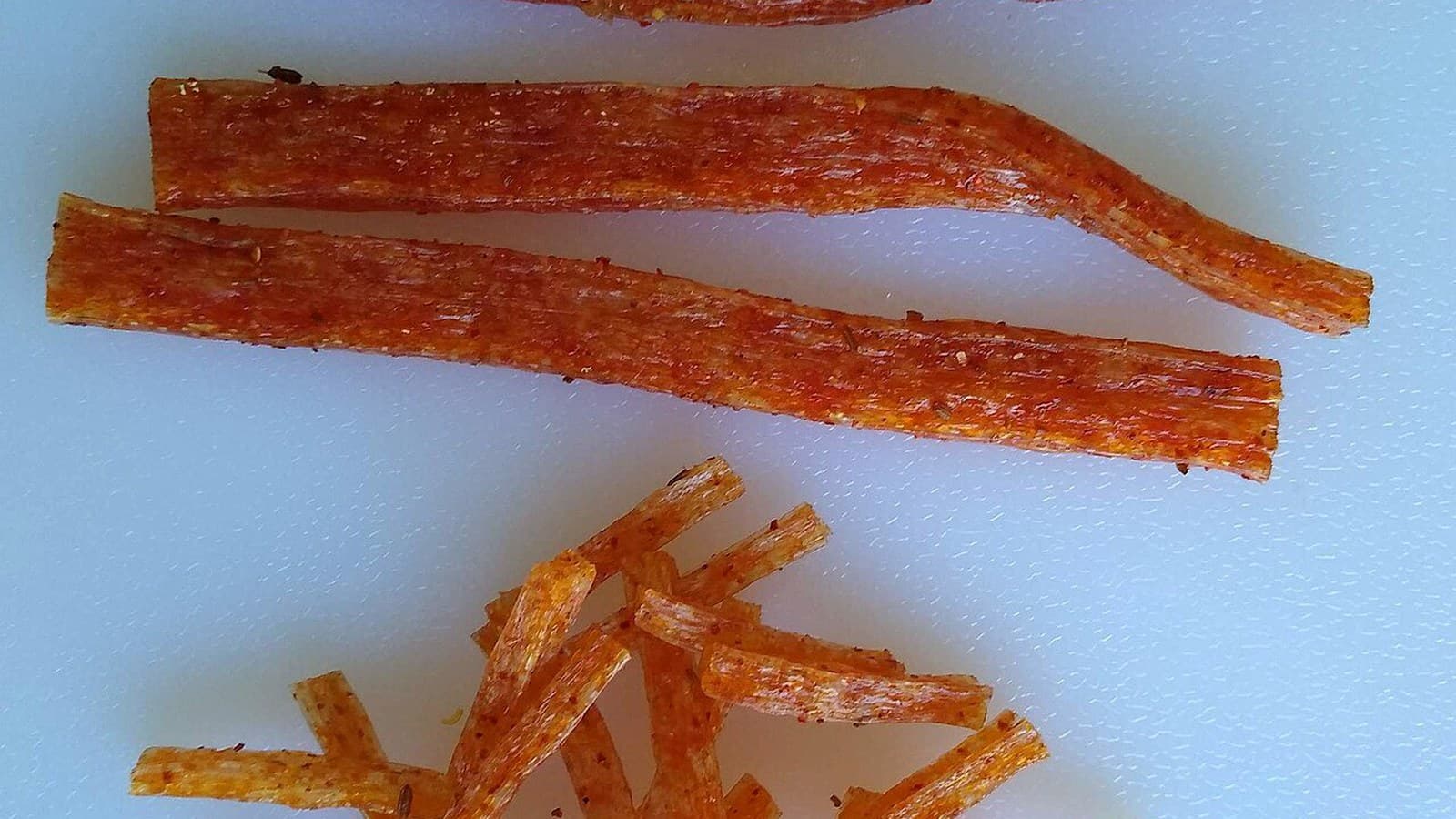
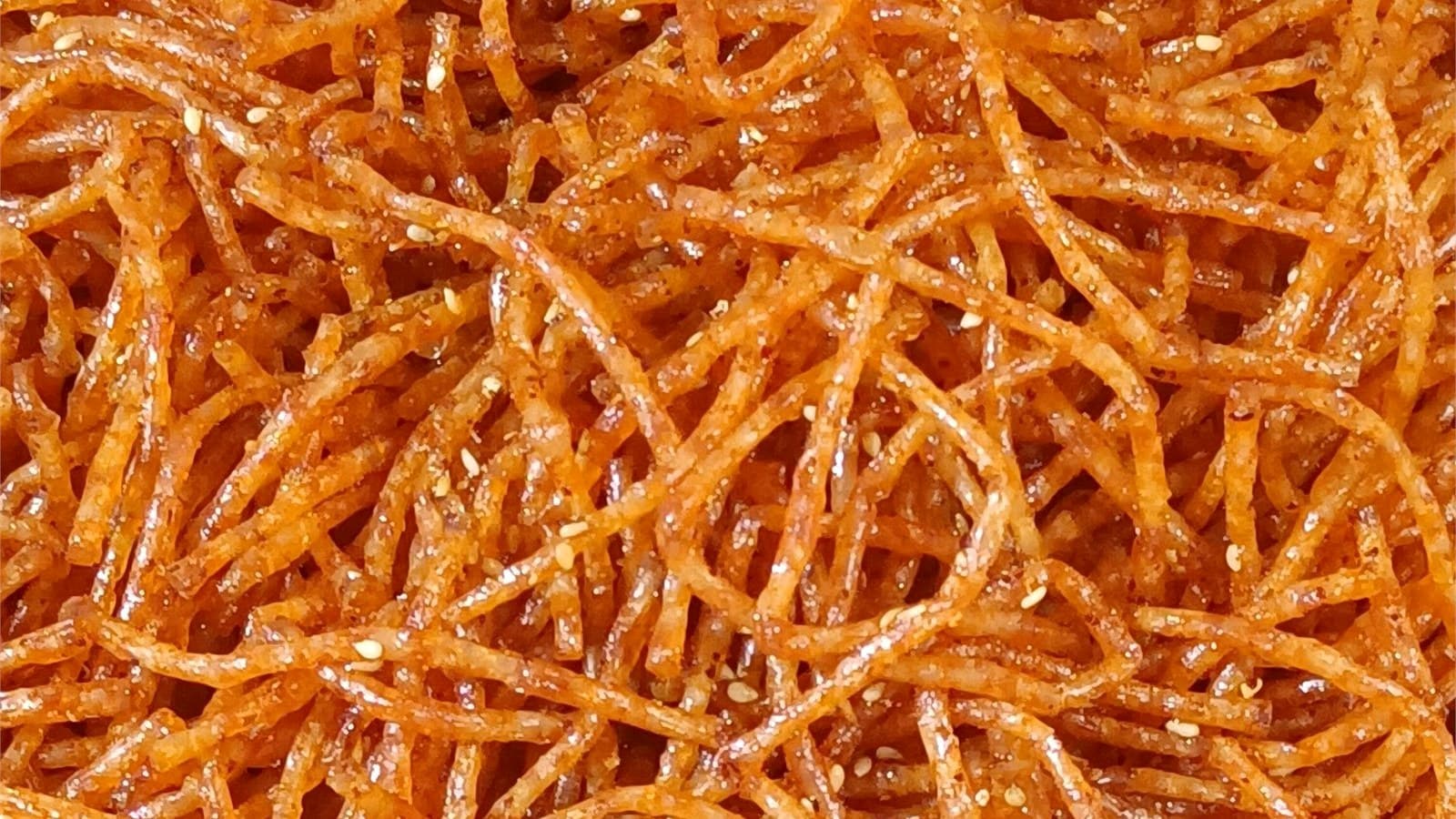
Latiao flavor is built as much by distribution as by recipe. A strong chili blend can still taste flat if the oil, seasoning, and snack base do not meet evenly. This page focuses on the formulation percentages and tumbling mechanics that turn a recipe into a finished snack — the engineering layer that explains why two chili-and-oil-based latiao can still taste completely different.
Reading a Latiao Formula in Percent
Industry-typical wheat-based latiao formulations distribute mass across six functional categories. The percentages below reflect typical published industry ranges (specific brands vary):
| Category | Mass % (industry-typical) | What it does |
|---|---|---|
| Wheat-base substrate | 60–70% | Structural protein scaffold (wheat gluten / vital wheat gluten) |
| Oil phase | 18–28% | Carrier for chili and aroma — chili oil 8–15% + neutral oil (palm/canola) 6–12% |
| Chili powder | 6–12% | Heat and color (二荆条 / 朝天椒 / 子弹头 varieties) |
| Sugar | 3–8% | Sweetness and Maillard browning during cooking |
| Salt | 2–4% | Seasoning baseline + preservation |
| Umami additives | 0.5–1.5% | MSG / I+G nucleotides / yeast extract for "savory punch" |
Three flavor archetypes emerge from how brands tilt these percentages:
- Sweet-oily archetype (Weilong Big Latiao baseline): higher sugar (~6–8%), lower chili (~6–8%), oil-forward profile
- Dry chili-forward archetype (Mala Prince classic): lower sugar (~3–5%), higher chili (~9–12%), drier mouthfeel
- Umami-heavy archetype (Fan Tian Wa wing-style): umami additives at 1.2–1.5%, more aromatic spice powder, "BBQ" memory
When a reviewer says one brand "tastes more like real chili" and another "tastes more like an MSG bomb", they're describing the umami-additives slider. When one says "oily" and another "dry", they're describing the oil-phase slider. The recipe disclosure on the package (ingredient order is by mass per GB 7718-2011) gives you exactly enough information to predict which archetype you're buying.
Chili oil composition · industry-typical %
Industry-typical chili oil composition by percent. This component only appears in the seasoning article — recipe percentages are its specific job.
- Vegetable oil base65%
- Chili powder20%
- Garlic / ginger powder4%
- Sesame4%
- Sichuan peppercorn2%
- Star anise / cinnamon2%
- Other3%
Tumbling Mechanics: RPM, Time, Temperature
After cooking, the snack moves to a seasoning drum (滚筒拌料机) where chili oil, spice powder, and umami additives are sprayed and tumbled into the substrate. The three parameters that decide whether you get even seasoning or "one bite hot, next bite bland":
- Drum RPM: industry-typical 12–18 RPM for 8–15 minutes. Above 25 RPM, breakage rate climbs sharply (broken pieces collect oil pools); below 8 RPM, the bottom of the drum gets oil-soaked while the top stays under-seasoned.
- Feed temperature: industry-typical 35–45°C — warm enough that oil viscosity drops and surface absorption improves, cool enough to avoid scorching delicate aromatic compounds.
- Total tumble time: industry-typical 8–15 minutes. Shorter = uneven coating; longer = oil pooling and visible breakage.
Industry-typical seasoning drums run at 12–18 RPM for 8–15 minutes with feed temperature 35–45°C; values above 25 RPM raise breakage and surface oil pooling per Food Engineering process notes.
The hidden insight: distribution beats recipe for flavor consistency. Two brands using identical chili-oil percentages can taste very different if one runs the drum well and the other runs it poorly. This is why factory experience matters — Pingjiang industrial park veterans are often paid premiums specifically for tumble-station expertise.
SHU and Pepper Varieties
The "heat" in latiao comes mostly from chili powder, and Chinese chili varieties have meaningful SHU differences:
- 二荆条 (Erjingtiao): ~30,000–50,000 SHU — fragrant, mid-spicy, the Sichuan hot-pot favorite
- 朝天椒 (Chao Tian Jiao / facing-heaven chili): ~40,000–60,000 SHU — sharper, more direct burn, the Hunan favorite
- 子弹头 (Zi Dan Tou / bullet chili): ~40,000–60,000 SHU — high pungency, Hunan/Guizhou region
- 印度魔鬼椒 (ghost pepper / bhut jolokia): ~1,000,000+ SHU — only used in extreme-heat variants, 0.1–0.5% in formula
A typical wheat latiao uses a blend rather than a single variety: e.g., 60% Erjingtiao for fragrance + 40% Chao Tian Jiao for burn. Pingjiang-school products lean Chao Tian Jiao heavy; Henan-school products use more Erjingtiao for the rounder, fragrant profile.
Flavor radar · 3 archetypes
3-archetype flavor radar comparing chili / sweet / umami / oily / numb. This component only appears in the seasoning article — flavor fingerprint is its specific job.
Weilong Big Latiao
- chili60
- sweet70
- umami65
- oily80
- numb0
Mala Prince classic
- chili85
- sweet35
- umami55
- oily60
- numb20
Fan Tian Wa wing-style
- chili70
- sweet50
- umami90
- oily75
- numb15
Additives & GB 2760
Industry-typical latiao formulas comply with GB 2760-2014 (food additive use limits). The most relevant categories for chewy spicy snacks:
- Preservatives: potassium sorbate (max 0.5 g/kg), dehydroacetic acid sodium (max 0.3 g/kg)
- Sweeteners: aspartame, acesulfame-K (where used) within standard limits
- Color stabilizers: TBHQ for oil oxidation control (max 0.2 g/kg)
The label disclosure rule: any additive used at ≥2% of total mass must be named explicitly per GB 7718-2011. Most preservatives and stabilizers are below this threshold, so they appear under generic "调味料 / 食品添加剂" wording — which is why ingredient-list scanning needs the full label, not just the front package.
Why Distribution Beats Recipe
Two latiao with identical formulas-on-paper can taste very different in the bag, and the explanation is almost always tumble-station execution. This is why Mala Prince feels "consistently sharp" while Fan Tian Wa feels "louder but uneven" — recipe percentages are similar; tumble execution differs.
It's also why freshness matters: oil distribution can shift during storage (gravity pulls oil downward in a sealed bag), so a 6-month-old product can feel "uneven" even if it tasted balanced fresh.
Final Take
Oil and seasoning explain the flavor; distribution explains why two similar formulas taste different. A good recipe still needs a well-tuned tumble station, a fresh pack, and a clear listing. When you encounter a "this is so much better than the other one" review of two seemingly similar brands, the answer is almost always in the distribution layer.
FAQ
Why does the same brand sometimes taste different in different bags?
Within-brand variation usually traces back to two causes: tumble drum residence time variation across shifts (the human-operated step in most lines), and chili oil age variation (oil pre-mixed in 200L drums can sit 2–7 days before being pumped to the tumbler — older oil tastes flatter). Within a 6-month period, expect 10–15% perceived flavor variation even from a single SKU.
Are MSG and yeast extract really interchangeable?
Not quite. MSG (sodium glutamate) provides clean savory umami at low cost. Yeast extract provides similar umami plus subtle "depth" notes from naturally-occurring nucleotides — but at 3–5× the cost. Brands use yeast extract for clean-label positioning rather than for measurable flavor superiority. For a savvy taster, the difference is detectable but small.
Why do some latiao brands taste oilier than others if they all use ~30% oil?
Oil "perceived oiliness" depends on three factors beyond raw quantity: (1) oil viscosity (refined oil feels less oily than first-press oil at the same dose); (2) emulsion stability (well-emulsified oil feels integrated; broken emulsion feels greasy on lips); (3) seasoning particle size (finer powder absorbs more oil into the suspension and feels less oily on the strip surface). These are formulation choices, not just oil amount.
Source Notes
- GB 2760-2014 食品添加剂使用标准 (food additive use limits) — covers MSG / I+G / sorbate ceilings cited in the recipe-percent breakdown
- GB/T 21266-2007 辣椒及辣椒制品中辣椒素类物质测定及辣度表示 — Chinese SHU measurement standard
- GB/T 30766-2014 辣条复合调味料 (compound seasoning standard) — formal national standard for latiao seasoning blends
- Cereal Foods World (AACCI) — published seasoning-drum process documentation
- Erjingtiao chili supply through Sichuan agricultural cooperatives — industry-association coverage of the dominant chili variety supply chain